How Big Is a 5x10 Storage Unit?
See a 5x10 unit (or a 5x5) in feet and meters, what operator guides say it holds, and add your own items to see how full it would be.
Recent
Your last 10 settings, saved only in this browser. Nothing is uploaded.
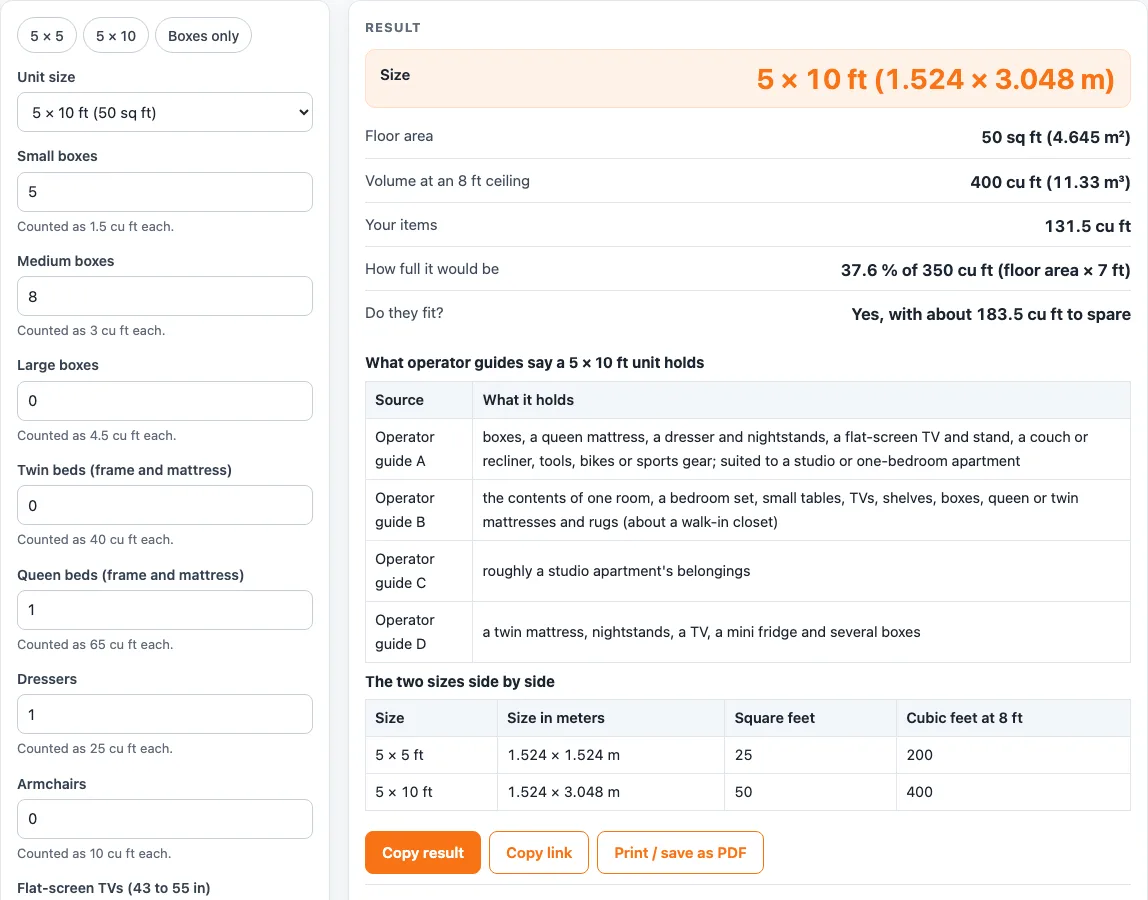
How to use the storage unit size calculator
- Open “Unit size”. It defaults to 5 × 10. Switch to 5 × 5 to compare.
- Enter how many “Small boxes”, “Medium boxes” and “Large boxes” you plan to store. These count as 1.5, 3 and 4.5 cu ft each.
- Enter your twin and queen beds, each with frame and mattress. A twin counts as 40 cu ft and a queen as 65 cu ft.
- Enter your dressers (25 cu ft each), armchairs (10 cu ft each), flat-screen TVs of 43 to 55 in (10 cu ft each) and bookcases (20 cu ft each).
- Under more options, set “Space to leave empty (%)”. It defaults to 10 percent. This is the page’s own planning allowance, not a figure from a source, so change it to suit your plans. “Usable stack height (ft)” is there too and defaults to 7.
- Read “How full it would be”. It shows the share of the unit’s usable volume your items would fill, calculated from your inputs.
- If your items are more than the unit allows with the empty space you set, “Do they fit?” says by how many cubic feet they are over and a warning appears. Remove items, lower the empty space or choose a larger unit.
- Before you rent, confirm the exact dimensions of the unit with the operator.
The presets “5 × 5”, “5 × 10” and “Boxes only” fill the form for you, and the side-by-side table lets you compare a 5 × 10 and a 5 × 5 without re-entering your items.
How do you work out how big a 5x10 storage unit is?
A 5 × 10 ft storage unit has 50 sq ft of floor. Multiply the length by the width: 5 × 10 = 50. Multiply that floor area by the ceiling height to get the volume. At an 8 ft ceiling, 50 × 8 = 400 cu ft.
The same method gives a 5 × 5 ft unit 25 sq ft of floor and 200 cu ft at 8 ft. To convert to metric, use 1 ft = 0.3048 m. The 5 × 10 unit measures 1.524 × 3.048 m, with 4.645 m² of floor and 11.33 m³ of space. The 5 × 5 unit measures 1.524 × 1.524 m, with 2.323 m² of floor and 5.663 m³ of space.
How is usable volume calculated for a storage unit?
Usable volume is the floor area multiplied by the stack height. The default stack height is 7 ft, which is the height the page uses for planning. A 5 × 10 gives 50 × 7 = 350 cu ft, and a 5 × 5 gives 25 × 7 = 175 cu ft.
The “Space to leave empty” setting reduces that figure to a target for the fit check. At the default 10 percent, a 5 × 10 has a target of 350 × 0.9 = 315 cu ft, and a 5 × 5 has a target of 157.5 cu ft. Each item’s volume is added up, and the total is divided by the usable volume (350 or 175 cu ft) to give the percentage shown. The target decides whether the items fit.
Here are three worked examples:
- 5 small boxes, 8 medium boxes, a queen bed, a dresser and a TV total 7.5 + 24 + 65 + 25 + 10 = 131.5 cu ft. That is 37.6 % of a 5 × 10.
- 10 small boxes and 10 medium boxes total 15 + 30 = 45 cu ft. That is 25.7 % of a 5 × 5.
- A twin bed, 15 medium boxes, a dresser, a bookcase and an armchair total 40 + 45 + 25 + 20 + 10 = 140 cu ft. That is 40 % of a 5 × 10.
Three queen beds total 195 cu ft. That is more than a 5 × 5 target of 157.5 cu ft, so the result would show that they are over by 37.5 cu ft.
Where do the item volumes come from?
Item volumes are packed cubic feet from the State of Alaska Department of Public Safety “Household Goods Move Cube Sheet” (revised 2024), which is a single source. The box volumes of 1.5, 3 and 4.5 cu ft for small, medium and large boxes come from a moving box guide. Real items vary, so treat the fill percentage as an estimate.
What do operator guides say a 5 × 5 holds?
The guides differ. One lists seasonal clothing, decor and documents and no large items. Another mentions tubs, boxes, clothing, small furniture, decor and up to 35 file boxes, about a hall closet. A third says up to 10 large moving boxes, a small desk or chair and seasonal items, and a fourth compact outdoor gear, small furniture such as an office chair and a few boxes.
Worked examples
| Input | Result |
|---|---|
| 5 × 10 ft, 5 kinds of item, stack height 7 ft | 131.5 cu ft, 37.6 % full |
| 5 × 5 ft, no items | 25 sq ft, 200 cu ft |
| 5 × 5 ft, 2 kinds of item, stack height 7 ft | 45 cu ft, 25.7 % full |
| 5 × 10 ft, 6 kinds of item, stack height 7 ft | 147.5 cu ft, 42.1 % full |
| 5 × 10 ft, 2 kinds of item, stack height 7 ft | 180 cu ft, 51.4 % full |
Calculated by the tool above; open it with the same values to see each step.
Frequently asked questions
What can fit in a 5x10 storage unit?
One operator guide describes a 5 × 10 as suited to a studio or one-bedroom home’s belongings, and lists boxes, a queen mattress, a dresser and nightstands, a TV and stand, a couch or recliner, and tools and bikes. Another says the contents of one room or about a walk-in closet, a third roughly a studio apartment’s belongings, and a fourth a twin mattress, nightstands, a TV, a mini fridge and several boxes. The page shows each guide separately.
How big is a 5x10 storage unit in square meters?
A 5 × 10 ft unit has 4.645 m² of floor. Its volume at an 8 ft ceiling is 11.33 m³.
Do all 5x10 storage units measure exactly 5 by 10 feet?
No. Operators’ unit sizes vary slightly, so check the exact dimensions of the unit you plan to rent.
Do the operator guides agree on mattresses in a 5x10 unit?
No. Guide A says a queen mattress, guide B says queen or twin mattresses, and guide D says a twin mattress. Guide C does not name one.
Is the 10 percent empty space a required figure?
No. It is the page’s own planning allowance and is not taken from a source. You can change it in “Space to leave empty”.
What is the difference between a 5x10 and a 5x5 unit?
A 5 × 10 has 50 sq ft of floor and 400 cu ft at 8 ft. A 5 × 5 has 25 sq ft and 200 cu ft at 8 ft, which is half the size.
Related tools
- How Big Is a 10x10 Storage Unit?: Use this when your belongings may need more floor space than a 5 × 10 provides.
- Moving Box Calculator: Use this to estimate how many boxes you will need before you pack.
- Moving Box Sizes: Use this to compare the box sizes this tool’s volumes are based on.
- What Size Storage Unit for a Car?: Use this if you plan to store a vehicle rather than household items.
- Storage Unit Sizes: Use this to compare the common unit sizes side by side.
- What Size Storage Unit Do I Need?: Use this to match a unit size to a general list of what you are storing.