Closet Rod Height
Choose who uses the closet, one rod or two, and a guide to get rod and shelf heights from the floor, checked against your ceiling.
Recent
Your last 10 settings, saved only in this browser. Nothing is uploaded.
How to use the Closet Rod Height Tool
- Choose who uses the closet: an adult standing, a small child, or a wheelchair user.
- Choose one rod or two rods.
- Pick the guide to follow: the home-repair guide, the home-living guide, or the closet-maker guide. Each guide gives its own figures, so switch guides to compare them.
- Enter your ceiling height. Select inches, feet, centimeters or meters, then type the number.
- Read the rod height from the floor. With two rods, read the upper rod, the lower rod and the distance between them.
- Read the shelf height. Where a guide gives no shelf height, the tool says to leave at least 2 in from the top of the rod to the bottom of the shelf (home-repair guide).
- Read the warnings. The tool warns if the top of the setup is above your ceiling, or if the ceiling is under 72 in.
- For a wheelchair user, check each rod against the 15 to 48 in reach range. The tool marks each rod as inside the range or above the 48 in reach limit.
- Check the rod distance from the back wall, the shelf depth and the shelf spacing shown with every result.
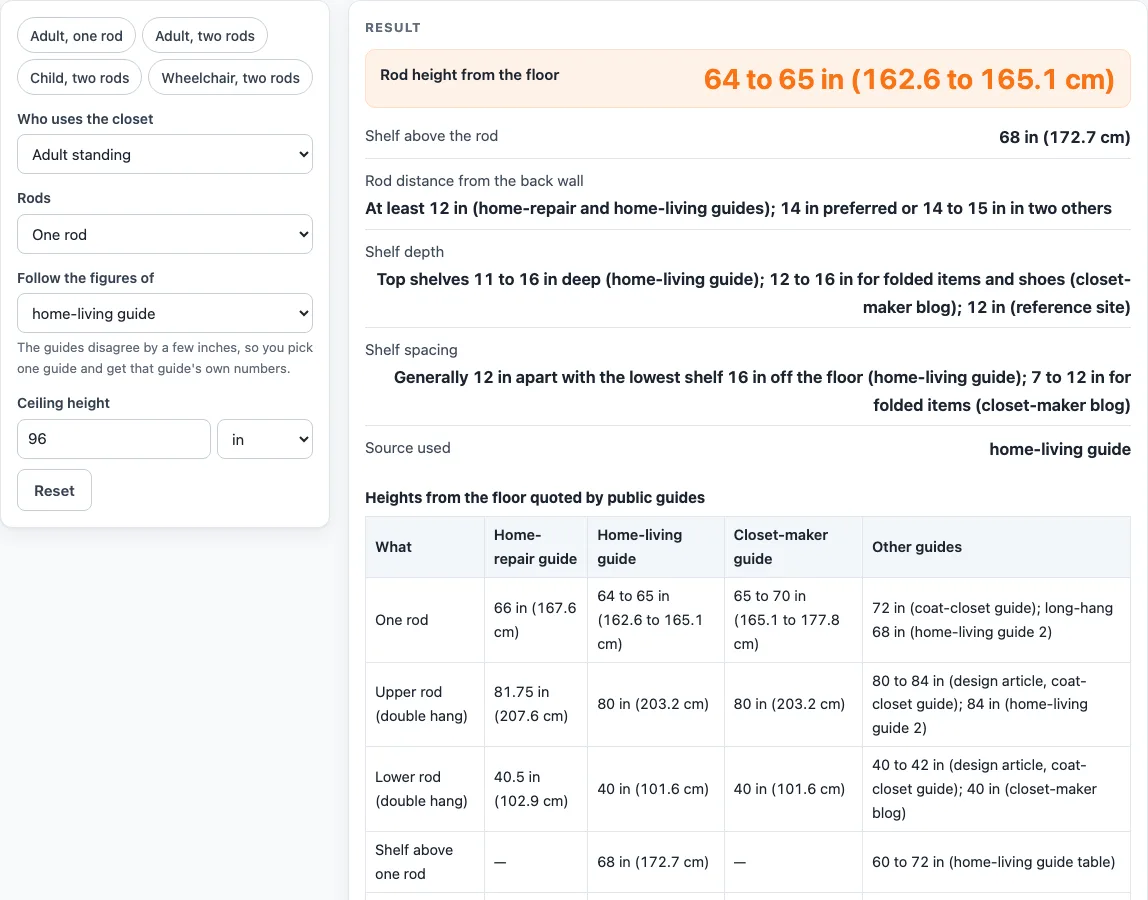
The chart lists every figure by guide, including the figures of the other guides, so you can see where they agree and where they differ. A blank, non-numeric, zero or negative ceiling height stops the calculation, so enter a positive number.
How is the closet rod height worked out?
The tool does not run a formula. It takes the figure from the guide you choose for the user and the number of rods, then checks the top of the setup against your ceiling height. The results are calculated from your inputs, using the figures in that guide.
For an adult with one rod, the home-repair guide says 66 in, the home-living guide says 64 to 65 in with a shelf at about 68 in, and the closet-maker guide says 65 to 70 in. For an adult with two rods, the home-repair guide puts the upper rod at 81.75 in and the lower rod at 40.5 in, 41.25 in apart. The home-living and closet-maker guides put the rods at 80 in and 40 in, with a top shelf at 84 in. The home-living guide says to leave at least 3 ft between rods.
Here is a worked example. An adult, one rod, the home-living guide and a 96 in ceiling gives a rod at 64 to 65 in (162.6 to 165.1 cm) and a shelf at 68 in (172.7 cm). The chart’s table range for a shelf above one rod is 60 to 72 in.
Why do closet rod and shelf heights differ between guides and users?
The guides do not agree, and no building code sets rod heights. One rod ranges from 64 to 72 in across the guides, the top rod from 80 to 84 in, and the lower rod from 40 to 42 in. The sizes are typical figures from the named sources. Because users vary in height, adjust them to the garments you hang. One guide gives 68 in for long-hanging clothes.
Only the home-repair guide gives a figure for a small child: a lower rod at 30 in for a double-hang setup. No guide gives a single-rod height for a child, so the tool says so instead of inventing one.
For a wheelchair user, the tool shows the 2010 ADA Standards unobstructed reach range of 15 to 48 in above the floor. That range applies to operable parts in covered buildings, not home closets. The tool uses it only as a reach reference and makes no compliance claim. With the closet-maker guide and two rods, the 40 in lower rod is inside the range, and the 80 in upper rod is above it.
Rod distance from the back wall is at least 12 in in two guides, and 14 in or 14 to 15 in in two others. Shelf depth is 11 to 16 in for top shelves, and 12 to 16 in for folded items and shoes. Closet shelf depth figures vary by guide, so check the chart when you plan. Shelves are generally 12 in apart, with the lowest shelf 16 in off the floor, and 7 to 12 in apart for folded items.
Sources (checked 15 October 2026): bobvila.com · hunker.com · closetandbeyond.com · lazzoni.com · engineerfix.com · dimensions.com · ada.gov · hunker.com · hunker.com
Worked examples
| Input | Result |
|---|---|
| Adult standing, One rod, ceiling 96 in | 64 to 65 in (162.6 to 165.1 cm) |
| Adult standing, Two rods (double hang), ceiling 96 in | 81.75 in (207.6 cm) |
| Small child, Two rods (double hang), ceiling 96 in | 30 in (76.2 cm) for the lower rod of a small child (home-repair guide) |
| Wheelchair user (seated reach), Two rods (double hang), ceiling 96 in | 80 in (203.2 cm) — above the 48 in reach limit |
| Adult standing, One rod, ceiling 2.4 m | 65 to 70 in (165.1 to 177.8 cm) |
Calculated by the tool above; open it with the same values to see each step.
Frequently asked questions
What closet rod height should I use for an adult?
With one rod, the guides give 64 to 72 in from the floor, depending on the guide. Pick the guide you trust most, then check the figure against the clothes you hang.
What is the closet shelf height?
For one rod, the home-living guide gives a shelf at about 68 in. Where a guide gives no shelf height, leave at least 2 in between the top of the rod and the bottom of the shelf.
Is there a closet rod height for a small child?
Only the home-repair guide gives one: a lower rod at 30 in for a double-hang setup. For a single rod, no guide gives a height, so the tool says so.
Does the tool show a closet rod height for a wheelchair user?
Yes. It marks each rod as inside the 15 to 48 in reach range or above the 48 in reach limit. The range comes from the 2010 ADA Standards, which apply to covered buildings, so the tool uses it only as a reference.
Why does the tool warn that my setup is above my ceiling?
The top of the setup, either the top shelf or the upper rod plus 2 in, is higher than the ceiling height you entered. Check the ceiling measurement and the guide you chose.
Is there a building code for closet rod height?
No building code sets rod heights. The figures are typical sizes from the named guides, so adjust them to your own height and clothes.
Related tools
- Closet Design Tool: Plan the layout of a closet.
- Standard Hanger Size: Look up hanger sizes.
- Standard Bookshelf Depth: Compare bookshelf depth figures.
- Standard Closet Depth: Look up closet depth figures.
- Walk-In Closet Dimensions: Check walk-in closet sizes.
- Closet and shelf sizes: See every closet and shelf size tool on the site.