Standard Hanger Size
See the width and thickness of common hangers, then enter your rod length and a hanger type to count how many hangers fit.
Recent
Your last 10 settings, saved only in this browser. Nothing is uploaded.
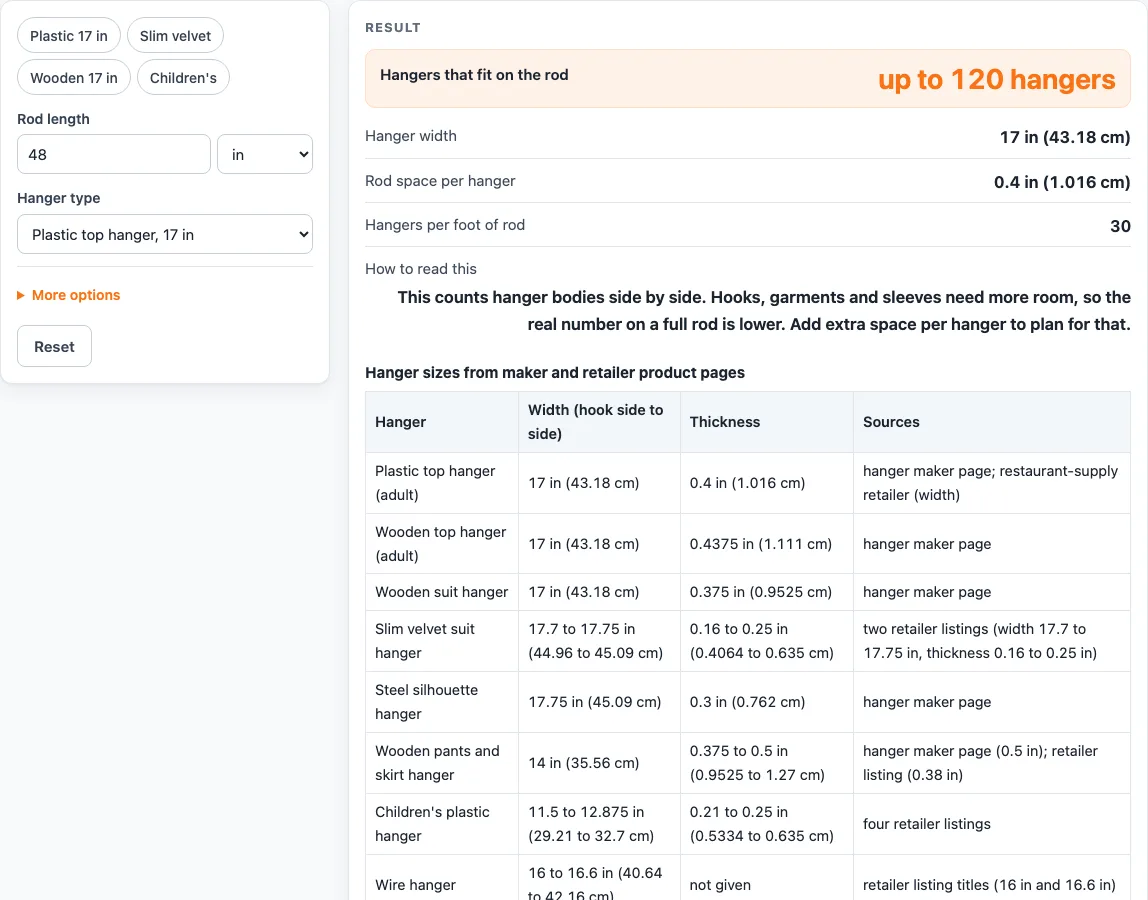
How to use the Hanger Size Calculator
Enter your “Rod length” and pick its unit: inches, feet, centimeters or meters.
Choose a “Hanger type” from the list, or pick a preset: “Plastic 17 in”, “Slim velvet”, “Wooden 17 in” or “Children’s”.
For wire or heavy-coat hangers the chart has no thickness. Choose “My own thickness” and enter the “Hanger thickness” you measured.
Open more options. In “Hangers you want to hang (optional)”, enter a whole number above zero to see how much rod that many hangers need.
In “Extra space per hanger”, enter any room you want to leave for hooks, garments or sleeves. It starts at 0.
Read the results:
- “Hangers that fit on the rod”
- “Hanger width”
- “Rod space per hanger”
- “Hangers per foot of rod”
- “Rod needed for your hangers”, if you entered a number wanted
Compare the hanger’s width with the depth of your closet before you buy. The chart lists width, thickness and sources for every type, including wire and heavy-coat hangers.
The calculator shows an error if a box is blank, contains text, or holds a zero or negative rod length or thickness. A negative extra space, or a hangers-wanted value that is not a whole number above zero, also triggers an error. A rod shorter than 6 in shows a warning, since it is often a unit mistake. A thickness outside 0.1 to 3 in also triggers a warning.
What is a standard hanger size?
There is no single standard hanger size. The chart shows ranges because each hanger type and each maker differs, and the sources do not agree on one number. The most common listing for an adult top hanger is 17 in wide, but suit, wire and heavy-coat hangers each have their own width range.
How many hangers fit on a closet rod?
Start with the thickness of one hanger and add any extra space you leave for it. That total is the space per hanger, and the number of hangers that fit is the rod length divided by that space, rounded down. For example, a 48 in rod with 0.4 in plastic hangers holds up to 120 hangers. Each hanger takes 0.4 in, so the rod has room for 30 per foot. Hangers per foot is 12 divided by the space per hanger.
Thinner hangers fit more on the same rod. A 48 in rod with slim velvet hangers at 0.16 in thick holds up to 300. A 120 cm rod, which is 47.24 in, with 0.4375 in wooden hangers holds up to 107.
Why do hanger widths differ by type?
Width differs by hanger type and by maker. Adult top hangers are 17 in, slim velvet and steel suit hangers run from 17.7 to 17.75 in, and wire hangers are 16 to 16.6 in. Heavy-coat hangers are about 19 to 20 in, and children’s plastic hangers are 11.5 to 12.875 in.
Width and thickness do different jobs. Width decides whether the hanger fits the closet depth. Thickness decides how many hangers fit side by side on the rod.
How much extra space should I leave per hanger?
The extra space setting starts at 0, which counts hanger bodies only. Hooks, garments and sleeves need more room, so the real number on a full rod is lower than the result. Use the extra space setting to plan for that. For example, a 6 ft rod with a 1 in thick hanger of your own and 0.5 in extra space holds 48 hangers.
Sources (checked 15 October 2026): usa.mainetti.com · webstaurantstore.com · target.com · hunker.com · closetandbeyond.com · usa.mainetti.com · usa.mainetti.com · usa.mainetti.com · usa.mainetti.com · webstaurantstore.com
Worked examples
| Input | Result |
|---|---|
| 48 in rod, Plastic top hanger, 17 in | up to 120 hangers |
| 48 in rod, Slim velvet hanger | up to 300 hangers |
| 120 cm rod, Wooden top hanger, 17 in | up to 107 hangers |
| 48 in rod, Plastic top hanger, 17 in | up to 120 hangers |
| 6 ft rod, My own thickness | up to 48 hangers |
Calculated by the tool above; open it with the same values to see each step.
Frequently asked questions
Can I see the sizes in centimeters too?
Yes. The chart shows every width and thickness in inches and centimeters, using 1 in = 2.54 cm exactly. The rod length box also accepts feet, centimeters or meters.
Why does my wire hanger have no thickness in the chart?
No source gave a thickness for wire or heavy-coat hangers. Enter your own thickness in the calculator, and it will use that value for the count.
What if I want to know how much rod a set number of hangers needs?
Enter the number in “Hangers you want to hang (optional)” under more options. The calculator then shows the rod length they need, which is that number times the space per hanger. For 50 plastic hangers at 0.4 in, that is 20 in of rod.
Why do the pants hanger thickness numbers differ?
One hanger maker lists pants hangers at 1/2 in thick, while a retailer listing gives 0.38 in. The chart shows the range 0.375 to 0.5 in, so check your own hanger if the count matters.
Does my closet need to be 24 in deep?
Closet guides say 24 in is the usual minimum depth for hanging clothes. Compare the hanger’s width with your closet depth before you buy, since a hanger must fit inside it.
Does the calculator store my numbers?
Everything runs in your browser, and nothing is uploaded. There is no sign-up, and the tool is free to use.
Related tools
- Closet Design Tool: Use it to lay out a closet and plan where your rod and hangers will go.
- Closet Rod Height: Use it to check how high to mount a rod for the clothes you hang.
- Standard Bookshelf Depth: Use it when you are sizing shelves rather than hanging clothes.
- Standard Closet Depth: Use it to check whether your closet is deep enough for the hanger width you need.
- Walk-In Closet Dimensions: Use it when you are planning a larger closet with more than one rod to fill with hangers.