Moving Box Sizes
Compare the sizes four public guides give for every common moving box, in inches or centimeters, with cubic feet and what each box is for.
Recent
Your last 10 settings, saved only in this browser. Nothing is uploaded.
How to use the Moving Box Sizes chart
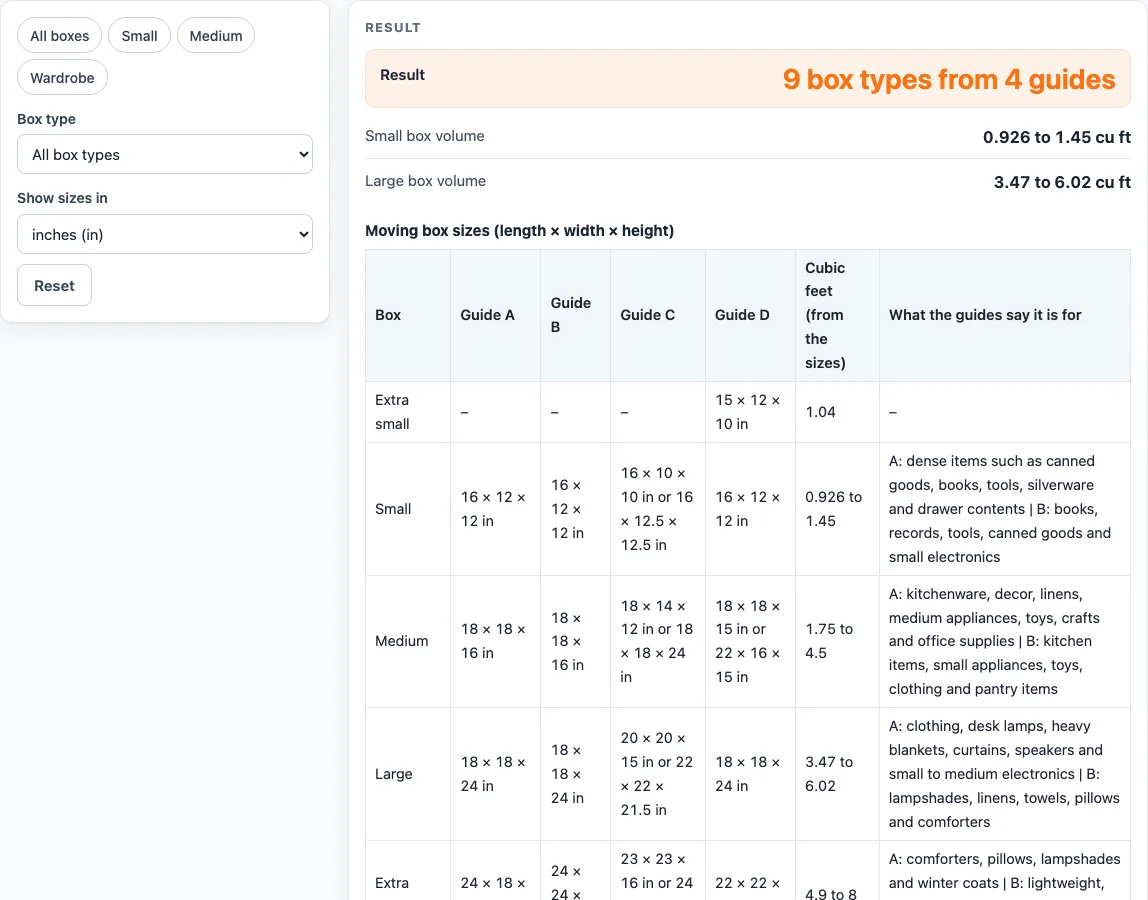
- Leave “Box type” on “All box types” to see the full chart. Each of the nine box types is a row, with columns for Guide A, Guide B, Guide C and Guide D.
- To look at one box type, choose it under “Box type”, or click a preset: “All boxes”, “Small”, “Medium” or “Wardrobe”. The table then shows only that row.
- Read the warning if it appears. It means the guides list different sizes for that box.
- Find the dashes. A dash means that guide does not list that box type.
- Compare the column “Cubic feet (from the sizes)”. It runs from the smallest to the largest result, worked out from the listed sizes.
- Read “What the guides say it is for” to see the uses that guides A and B give.
- For metric sizes, set “Show sizes in” to centimeters (cm). One inch equals 2.54 cm.
- With “All box types” selected, scroll down to “Plastic tote sizes in gallons” for gallon sizes with their nominal cubic feet. “Tote examples with labelled sizes” shows outside sizes and volumes.
- Before you buy, check the size printed on the box, because it may differ from any guide.
A preset only changes the box type, so you can still change the unit afterward. Use the box type selector when you need one box with its full set of guide sizes.
How are cubic feet calculated for a moving box?
Cubic feet are found by multiplying length, width and height in inches, then dividing by 1,728 (the number of cubic inches in a cubic foot). The chart does this for each listed size and shows the smallest to largest result per box type. For example, a small box at 16 × 12 × 12 in gives 2,304 ÷ 1,728, which is about 1.33 cu ft. Across the sizes the guides list, small boxes run from 0.926 to 1.45 cu ft and medium boxes from 1.75 to 4.5 cu ft.
Why do the four guides list different box sizes?
Each guide publishes its own dimensions, and the same box type can appear at more than one size. For example, guide C lists a medium box at 18 × 14 × 12 in or 18 × 18 × 24 in, while guides A and B list 18 × 18 × 16 in. Guide C’s 18 × 18 × 24 in box is the one other guides call large. Extra large is 24 × 18 × 24 in in guide A but 24 × 24 × 24 in in guide B. Because of this, the chart shows the guides side by side instead of picking one. Only some guides list the extra small box, dish pack, book box and glass pack, which is why dashes appear.
What are moving boxes used for?
Guides A and B describe uses, and their lists are not identical, so the page shows both. For small boxes they name dense items such as books, tools and canned goods. For medium boxes, both name kitchen items, small appliances and toys. For large boxes, guide A lists clothing, lamps, heavy blankets and curtains, while guide B lists lampshades, linens, towels, pillows and comforters. Extra large boxes are for bulky items such as comforters, pillows and coats in guide A and blankets and sports gear in guide B. Wardrobe boxes are for hanging clothes.
How is a plastic tote’s volume worked out?
Plastic totes are sized in gallons, and the volume is worked out with 1 US gallon = 231 cubic inches. The formula is gallons × 231 ÷ 1,728, so a 12-gallon tote is about 1.6 cu ft and a 20-gallon tote is about 2.67 cu ft. This is a nominal volume. The outside dimensions are larger, so a 30-gallon tote measuring 16.09 × 21.92 × 32.42 in outside comes to about 6.62 cu ft.
Sources (checked 15 October 2026): hireahelper.com · cubesmart.com · storagecafe.com · uhaul.com · publicstorage.com · aws.state.ak.us · hondanews.com · fromtheroad.ford.com · tsishipping.com · thumbtack.com · redfin.com · storagecafe.com
Worked examples
| Input | Result |
|---|---|
| All box types, inches | 9 box types listed |
| Medium, sizes in inches (in) | Medium: 1.75 to 4.5 cu ft |
| Wardrobe, sizes in centimeters (cm) | Wardrobe: 10.1 to 14 cu ft |
| Small, sizes in inches (in) | Small: 0.926 to 1.45 cu ft |
| Dish pack, sizes in inches (in) | Dish pack: 1.84 cu ft |
Calculated by the tool above; open it with the same values to see each step.
Frequently asked questions
What size is a small moving box?
Guides A, B and D list a small box at 16 × 12 × 12 in, which is about 1.33 cu ft. Guide C lists 16 × 10 × 10 in or 16 × 12.5 × 12.5 in. Check the size printed on the box you buy.
Are tote sizes the same as packing box sizes?
No. Totes are sized in gallons, while packing boxes are given in inches or centimeters. The chart converts tote gallons to nominal cubic feet so you can compare them.
Can I see the sizes in centimeters?
Yes. Set “Show sizes in” to centimeters (cm). One inch equals 2.54 cm.
Do moving boxes have weight limits?
Some guides state them. Guide A gives up to 65 lb for common boxes, 100 lb for wardrobe boxes and 120 lb for glass packs, and guide C gives 60 to 70 lb. The chart does not show these limits and does not use them in the cubic feet figures.
Why are some cells in the chart a dash?
A dash means that guide does not list that box type. For example, the extra small box is listed only by guide D, and the dish pack, book box and glass pack only by guide A.
Will every box match the chart?
Not always. Sizes vary by supplier and by box, so the chart shows what four guides list. Always check the size printed on the box you buy.
Related tools
- Moving Box Calculator: use this when you want to estimate how many boxes your belongings need.
- Storage Unit Sizes: use this to compare the storage unit sizes available for your move.
- What Size Storage Unit Do I Need?: use this when you are choosing a unit size based on what you are storing.
- How Big Is a 10x10 Storage Unit?: use this to see how much room a 10x10 unit gives.
- How Big Is a 5x10 Storage Unit?: use this to see how much room a 5x10 unit gives.
- Storage and Moving: browse all the storage and moving tools in one place.
- Moving Out Checklist: use this to plan the jobs around your boxes.
- Declutter Checklist: use this to sort what goes in a box before you pack.