Refrigerator Dimensions
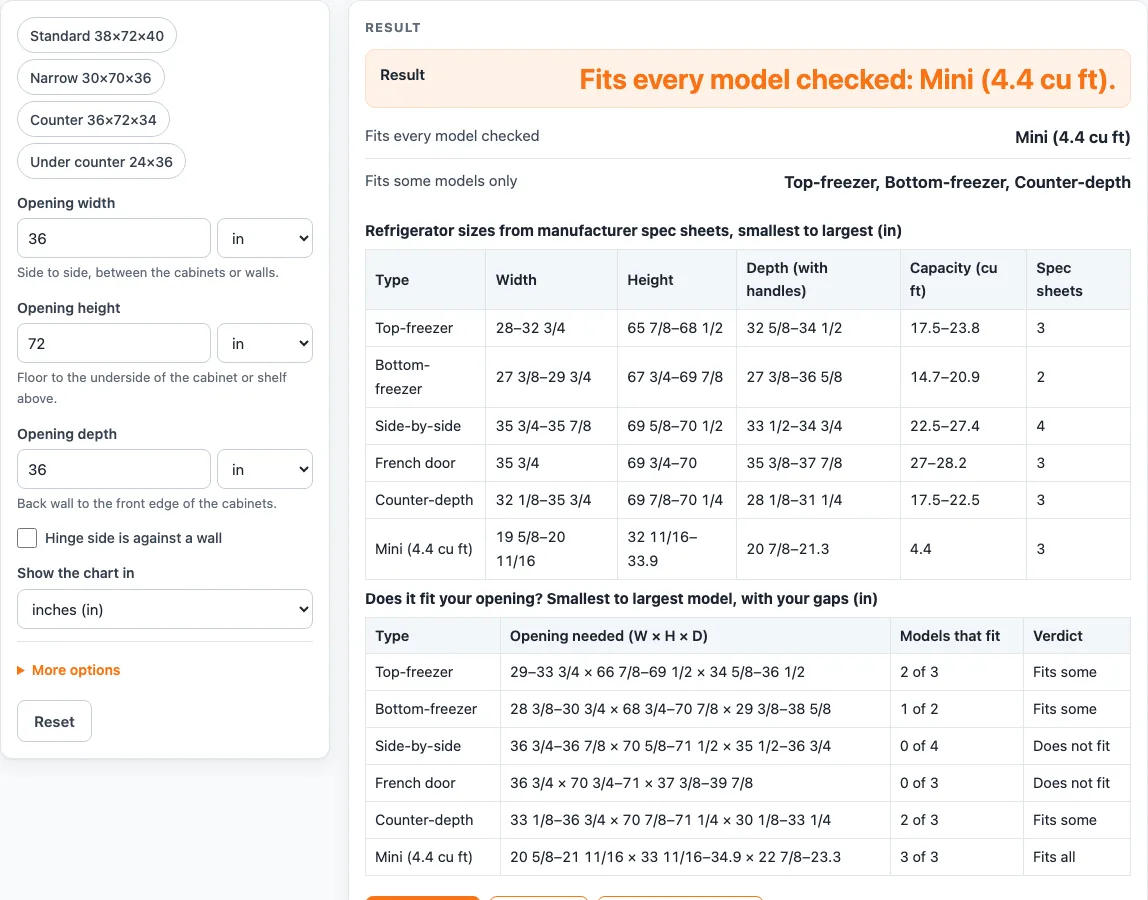
Enter the width, height and depth of your opening to see which refrigerator types fit, next to a chart of sizes and capacities from manufacturer spec sheets.
Recent
Your last 10 settings, saved only in this browser. Nothing is uploaded.
How to use the refrigerator dimensions tool
- Measure the space where the fridge will go. Width is side to side between the cabinets or walls, height is floor to the underside of the cabinet or shelf above, and depth is the back wall to the front edge of the cabinets.
- Enter “Opening width”, “Opening height” and “Opening depth”. Each accepts inches, feet, cm or m.
- Use “Show the chart in” to choose inches or centimeters.
- If the hinge side of the fridge will sit beside a wall, tick “Hinge side is against a wall”.
- Open “More options” to change “Air gap at each side (in)”, “Air gap above (in)”, “Space behind (in)” or, once the wall box is ticked, “Extra space on the hinge side (in)”. The defaults are 1/2 in at each side, 1 in above, 2 in behind and 2 1/2 in extra on a hinge side next to a wall.
- Read “Result”, which lists the types where every model checked fits, then the types where only some do.
- Check the second table. For each type it shows the opening needed, how many models fit, and a verdict of “Fits all”, “Fits some” or “Does not fit”.
- Check the installation guide for the exact model you plan to buy.
The presets “Standard 38×72×40”, “Narrow 30×70×36”, “Counter 36×72×34” and “Under counter 24×36” fill in example openings. Warnings appear if the opening looks unusual for a refrigerator or if the gaps you entered are larger than anything on the spec sheets.
How does the fit check work out the opening a refrigerator needs?
The fit check adds the required gaps to each model’s size, then compares that total with the opening you enter. For every model it works out the opening it needs: width is the model width plus a gap at each side (or the open side gap plus the hinge-side space when a wall is checked), height is the model height plus the gap above, and depth is the model depth with handles plus the gap behind.
For example, take an opening 36 in wide, 72 in high and 36 in deep, with the default gaps. Mini refrigerators fit all 3 models. Top-freezer models fit 2 of 3, counter-depth models fit 2 of 3 and bottom-freezer models fit 1 of 2. Side-by-side models need 36 3/4 to 36 7/8 in of width, so they do not fit. French door models need 36 3/4 in of width and 37 3/8 to 39 7/8 in of depth, so they do not fit either.
Now change only the depth to 34 in. Counter-depth models fit 2 of 3, because the 35 3/4 in wide model needs 36 3/4 in of width once the side gaps are added, and that is more than the 36 in you entered.
Why do refrigerator dimensions vary so much between types and models?
Sizes differ by type, maker and model, so the page shows ranges rather than averages. Across the spec sheets, top-freezer models are 28 to 32 3/4 in wide, bottom-freezer models 27 3/8 to 29 3/4 in, side-by-side models 35 3/4 to 35 7/8 in and French door models 35 3/4 in. Full-size side-by-side and French door units are about 36 in wide, while top and bottom freezers run about 28 to 33 in wide.
Counter-depth is a marketing term, not a rule. Counter-depth models are about 28 to 31 in deep with handles, compared with 33 to 38 in for standard-depth French door and side-by-side models. The sheets show a 3 in spread within the counter-depth group alone, so a counter-depth label does not guarantee one exact depth. The page does not say that counter-depth models sit flush with a 24 in counter.
Heights are the tallest figure each sheet gives, either to the top of the hinge or the overall height. Depths include the door handles, which is why a handle can take up space that a flat-front measurement would miss.
Gap advice also differs by maker. Some sheets allow 1/8 to 3/4 in at the sides, others ask for 3/8 in at the sides and top, and hinge-side clearances range from 2 in to 3 3/4 in. The fit check uses the defaults unless you change them, so compare your gaps with the installation guide for your model.
Sources (checked 15 October 2026): static.pcrichard.com · assets.ajmadison.com · static.pcrichard.com
Worked examples
| Input | Result |
|---|---|
| Opening 36 in × 72 in × 36 in | 1 types fit every model checked |
| Opening 30 in × 70 in × 36 in | 1 types fit every model checked |
| Opening 36 in × 72 in × 34 in | 1 types fit every model checked |
| Opening 24 in × 36 in × 26 in | 1 types fit every model checked |
| Opening 95 cm × 180 cm × 85 cm | 1 types fit every model checked |
Calculated by the tool above; open it with the same values to see each step.
Frequently asked questions
What are standard refrigerator dimensions, or the standard fridge size?
There is no single standard fridge size, because it depends on the type. Full-size side-by-side and French door models are about 36 in wide, and top and bottom freezers are about 28 to 33 in wide. The top-freezer range is 65 7/8 to 68 1/2 in high. These are typical sizes from the named spec sheets, so check the installation guide for your exact model.
What are mini fridge dimensions?
Mini refrigerators in the chart are 19 5/8 to 20 11/16 in wide, 32 11/16 to 33.9 in high and 20 7/8 to 21.3 in deep with handles. They hold 4.4 cubic feet, and the range comes from 3 spec sheets.
What are normal size fridge dimensions?
Normal size fridge dimensions depend on the type. The chart shows top-freezer models from 17.5 to 23.8 cubic feet and side-by-side models from 22.5 to 27.4 cubic feet. Use the row for the type you want to see the smallest-to-largest width, height and depth.
How deep is a counter depth refrigerator?
Counter-depth models in the chart are 28 1/8 to 31 1/4 in deep with handles. That range is from 3 spec sheets, and the label is not a fixed rule, so measure the depth you need.
Does the fit check confirm that a fridge will fit my kitchen?
No. The result is calculated from the numbers you enter and the spec sheet sizes. It does not check doorway width, water-line space or door swing, so read the model’s installation guide for those.
Why does a type show “does not fit”?
The verdict means that the opening you entered is smaller than the space each model of that type needs once the gaps are added. Check the opening needed in the second table, then confirm the gaps in the installation guide of the model you want. “Does not fit” applies to every model checked of that type, and “Fits some” means only some of them fit.
Related tools
- Dishwasher Dimensions: use it when you are planning a dishwasher space next to the fridge.
- Standard Kitchen Cabinet Sizes: use it to compare cabinet sizes when fitting a fridge into a run of cabinets.
- Laundry Room Dimensions: use it when the fridge shares a utility area with other appliances.
- Pantry Dimensions: use it when you want to compare a pantry space with a fridge opening.
- Standard Closet Depth: use it to compare other built-in depths when planning a utility space.
- Washer and Dryer Dimensions: use it when you are planning the sizes of laundry appliances in the same room.