Standard Bookshelf Depth
Choose what the shelf holds and a clearance to get the depth it needs, and see how long a shelf board can span.
Recent
Your last 10 settings, saved only in this browser. Nothing is uploaded.
How to use the Standard Bookshelf Depth tool
- Under “What the shelf holds”, choose mass-market paperbacks, trade paperbacks, hardcovers and textbooks, art and coffee-table books, letter-size binders, DVD cases, vinyl LP records, or “Something else (enter its depth)”.
- If you chose something else, enter the “Depth of your deepest item”. It must be above zero.
- Set the “Clearance to add”. It starts at 1 in. Use 0 to see the bare item depth.
- Under “Show results in”, pick inches or centimeters.
- To check a shelf span, open more options. Pick the “Shelf board (3/4 in)”: plywood, particleboard, solid pine or solid red oak. Then enter “Your shelf span (optional)”, the distance between the two supports under one shelf. Leave it blank to skip.
- Read “Shelf depth at least”. It is the deepest value for your item plus the clearance.
- Read “Deepest item”, “Depths bookcases are sold in” and “Longest span for this board” for context.
- If you entered a span, “Your span” says whether it is within the shorter figure, between the two figures, or longer than both. “Longer spans” notes the cleat and face-strip options.
- Watch for messages. An item deeper than 16 in shows a warning, and so does a span longer than both figures. A negative clearance, or a zero or non-numeric item depth or span, shows an error.
- For a quick start, load a preset: Paperbacks, Hardcovers, Art books or Binders.
What is standard bookshelf depth?
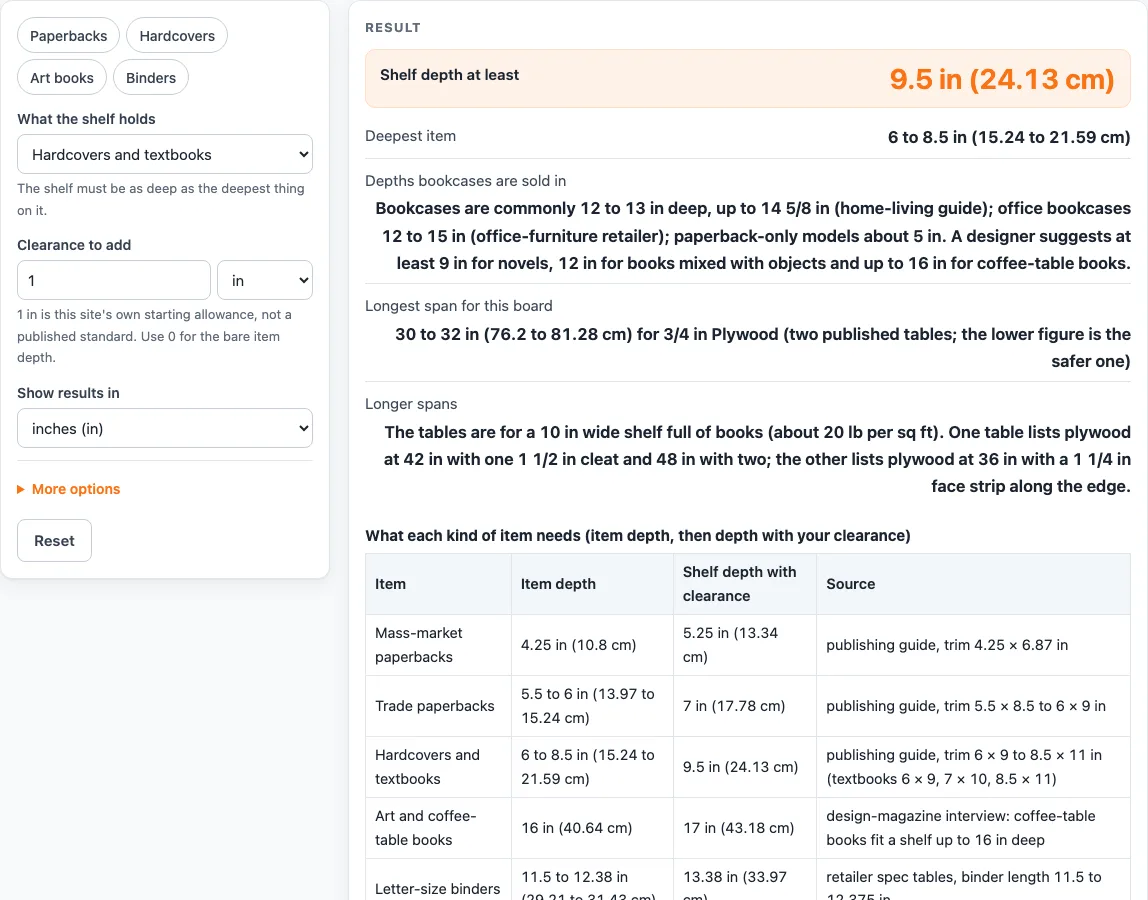
There is no single standard bookshelf depth. Sources differ and sizes vary by maker, so the figures here are typical sizes from public sources, not a rule. One home-living guide lists bookcases at 12 to 13 in deep (up to 14 5/8 in for four-shelf units), an office bookcase guide lists 12 to 15 in, and paperback-only models are about 5 in. A designer suggests at least 9 in for novels, 12 in for books mixed with objects, and up to 16 in for coffee-table books.
Depth for a book comes from its cover. A book standing on a shelf needs the width of its cover as depth, so the depth is the shorter trim dimension. For 8.5 x 11 in books, that is 8.5 in. Trim size is a publishing convention, not a standard, and it varies by genre and publisher. The item depths the tool uses are: mass-market paperback 4.25 in; trade paperback 5.5 to 6 in; hardcovers and textbooks 6 to 8.5 in; art and coffee-table books 16 in; letter-size binders 11.5 to 12.375 in; DVD case 5.31 in (135 mm); LP record 12 in, though the jacket is a little larger. The binder, DVD and LP figures come from retailer or reference pages, not from a standards body.
How is the recommended shelf depth calculated?
The recommended depth is the deepest value for your item, meaning the high end of its range, plus the clearance. For hardcovers with 1 in of clearance, that is 8.5 + 1 = 9.5 in (24.13 cm). For mass-market paperbacks with no clearance, it is 4.25 in (10.8 cm). Art books with 1 in of clearance need a shelf at least 17 in deep (43.18 cm). Letter-size binders with no clearance need 12.375 in, shown as 12.38 in. LP records with 1 in of clearance need 13 in.
The 1 in default is this site’s own starting allowance, not a published standard, and no source gives a clearance. Set it to 0 if you want only the item depth.
Shelf spans use a separate check. Two published tables give the longest span for a 3/4 in board, 10 in wide, holding a shelf full of books at about 20 lb per sq ft: 30 to 32 in for plywood, 24 to 26 in for particleboard, 36 in for solid pine and 44 in for solid red oak. The tables differ on plywood and particleboard, so the page shows both figures and says the lower one is the safer choice. Red oak appears in only one table. One table lists plywood at 42 in with one 1 1/2 in cleat or 48 in with two, and the other lists plywood at 36 in with a 1 1/4 in face strip along the edge.
The tool compares your span with these figures. For plywood, a 36 in span is longer than both figures and adds a warning, while a 28 in span is within the shorter figure. These tables are for books and are guidance, not engineering. Heavier loads need a shorter span or a stiffer board.
Sources (checked 15 October 2026): reedsy.com · livingetc.com · hunker.com · officefurniture2go.com · woodbin.com · craftisian.com · avery.com · walmart.com · en.wikipedia.org
Worked examples
| Input | Result |
|---|---|
| Hardcovers and textbooks, clearance 1 in | shelf depth at least 9.5 in |
| Mass-market paperbacks, clearance 1 in | shelf depth at least 5.25 in |
| Art and coffee-table books, clearance 1 in | shelf depth at least 17 in |
| Letter-size binders, clearance 0 in | shelf depth at least 12.38 in |
| Vinyl LP records, clearance 1 in | shelf depth at least 13 in |
Calculated by the tool above; open it with the same values to see each step.
Frequently asked questions
Is there one standard bookshelf depth?
No. The sources give different figures, and sizes vary by maker, so the tool calculates depth from the items you plan to store.
How deep should a bookshelf be for hardcovers?
With the default 1 in of clearance, the tool gives 9.5 in (24.13 cm), using 8.5 in as the deepest hardcover value. Set the clearance to 0 to see 8.5 in.
What depth do paperbacks need?
Mass-market paperbacks need 4.25 in (10.8 cm) with no clearance. Trade paperbacks use 6 in as their deepest value, so they need 7 in with the default clearance.
How deep should a bookcase be for coffee-table books?
The tool uses 16 in for art and coffee-table books, which a designer gives as the deepest shelf these books need. With 1 in of clearance, the result is 17 in.
How long can a bookshelf span be?
For a 3/4 in board, the page lists 30 to 32 in for plywood, 24 to 26 in for particleboard, 36 in for solid pine and 44 in for solid red oak. These are guidance for books, not engineering, so use a shorter span for heavier loads.
Why does the tool add 1 in of clearance?
It is this site’s own starting allowance, not a published standard, and no source gives a clearance. Change it to suit your shelf.
Related tools
See all closet and shelf size tools, or open one of these.
- Closet Design Tool: use it to plan the layout of a closet with the same kind of size checks.
- Closet Rod Height: use it when you need the height for a hanging rod.
- Standard Hanger Size: use it to check the width a hanger needs in a closet.
- Standard Closet Depth: use it when you are sizing the depth of a closet rather than a bookshelf.
- Walk-In Closet Dimensions: use it to compare the room sizes for a larger closet.