Storage Unit Sizes
See the common self-storage sizes from 5x5 to 10x30 with floor area, volume and what operator guides say each one holds; pick one size to focus on it.
Recent
Your last 10 settings, saved only in this browser. Nothing is uploaded.
How to use the storage unit size chart
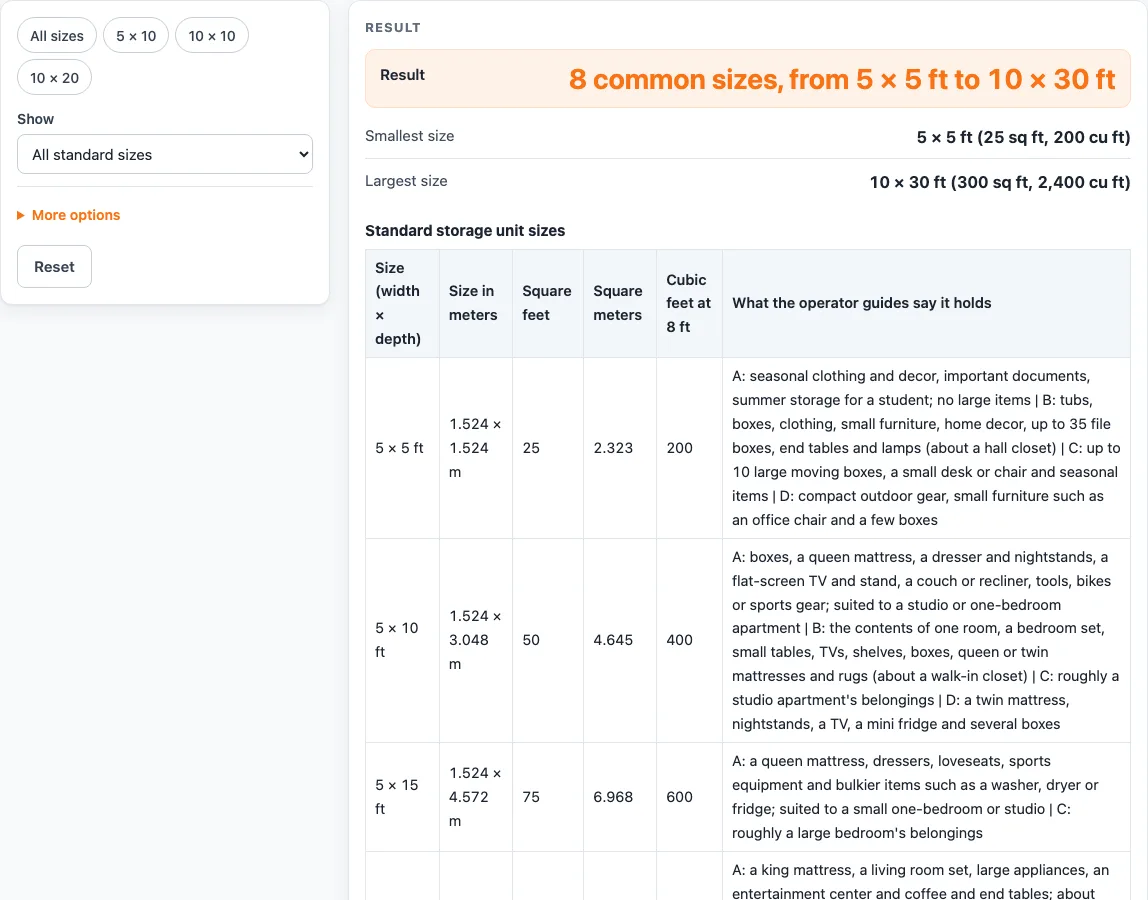
- Open the chart. It starts on “All standard sizes”, so you see all eight rows from 5 × 5 to 10 × 30 ft.
- Read the “Size (width × depth)” column and the “Size in meters” column. A 5 × 10 ft unit is 1.524 × 3.048 m.
- Check the floor area in square feet and square meters, then the cubic feet at the ceiling height shown in the column heading.
- Read the “What the operator guides say it holds” column and compare each description with your own list of furniture, boxes or a vehicle. The guides often disagree, and the chart shows that as it is.
- To focus on one size, choose it in the “Show” menu, or click the “5 × 10”, “10 × 10” or “10 × 20” preset. The chart then shows only that row, with its square feet, cubic feet and how many guides describe it. The “All sizes” preset brings back the full list.
- If your unit is taller or shorter than 8 ft, open “More options” and change “Ceiling height (ft)”. It accepts 4 to 14 ft, and the cubic feet follow it. A warning notes that the cubic feet now differ from the guides’ figures.
- Use the step lines under the result to see the rule: width times depth, times ceiling height, and feet times 0.3048 for meters.
- Confirm the exact dimensions with the facility before you rent, because sizes vary by operator and location. Nothing you enter is stored or uploaded.
How does a storage unit size guide calculate floor area and volume?
A storage unit’s floor area is its width multiplied by its depth, so a 10 × 20 ft unit has 200 sq ft of floor. Its cubic feet come from multiplying that floor area by the ceiling height, which is 8 ft by default in this chart.
Floor area is width × depth, so the eight sizes give 25, 50, 75, 100, 150, 200, 250 and 300 sq ft. With the default 8 ft ceiling, the cubic feet are 200, 400, 600, 800, 1,200, 1,600, 2,000 and 2,400. The 8 ft figure follows operator guide B, which lists every unit as 8 ft high, and operator guide D, which says standard units are about 8 ft tall while some facilities have 10 to 12 ft. If your unit is taller, change the ceiling height setting and the cubic feet change with it. The cubic feet then differ from the guides’ figures, which is why a warning appears.
Metric figures use a fixed conversion: feet multiplied by 0.3048 gives meters exactly. A 5 × 10 ft unit is 1.524 × 3.048 m, its 50 sq ft is 4.645 m², and its 400 cu ft is 11.33 m³. You can apply the same multiplication to any dimension you measure in feet.
Why does each self storage size guide describe sizes differently?
The operator guides do not agree on exact dimensions, so there is no single correct answer for any size. Each self storage size guide gives typical sizes in its own words, and the same footprint can be described in different ways. Take 10 × 10 ft: operator guide A says it is about three rooms’ worth, B says roughly a one-bedroom home, C says two small bedrooms, and D says a studio or one-bedroom apartment. The chart shows these conflicts as they are rather than smoothing them over.
Coverage also varies. Operator guides A and C list 5 × 15 and 10 × 25 ft, while B and D do not. Guide A places 10 × 25 at vehicles, a boat and ATVs, and guide C places it at a four-bedroom home. Some descriptions are counts of items rather than rooms. Guide B says a 5 × 5 holds up to 35 file boxes, about a hall closet, so treat each description as a starting point and compare it with your own list.
For this reason the chart gives no average storage unit size. Sizes are approximate and vary slightly by operator and location, so the exact unit at the facility you plan to use is the final check.
Sources (checked 15 October 2026): cubesmart.com · storagecafe.com · uhaul.com · publicstorage.com · aws.state.ak.us · hireahelper.com · hondanews.com · fromtheroad.ford.com · tsishipping.com · thumbtack.com · redfin.com · storagecafe.com
Worked examples
| Input | Result |
|---|---|
| All sizes, ceiling 8 ft | 8 sizes listed |
| 5 × 10 ft, ceiling 8 ft | 5 × 10 ft: 50 sq ft, 400 cu ft |
| 10 × 10 ft, ceiling 8 ft | 10 × 10 ft: 100 sq ft, 800 cu ft |
| 10 × 20 ft, ceiling 9 ft | 10 × 20 ft: 200 sq ft, 1,800 cu ft |
| 5 × 5 ft, ceiling 8 ft | 5 × 5 ft: 25 sq ft, 200 cu ft |
Calculated by the tool above; open it with the same values to see each step.
Frequently asked questions
What are the smallest and largest storage unit sizes in this chart?
The smallest is 5 × 5 ft, which has 25 sq ft of floor. The largest is 10 × 30 ft, which has 300 sq ft.
Is there an average storage unit size?
No. The page does not give an average, and the guides do not agree on one average unit.
Can a self storage size guide replace measuring my items?
Not on its own. The guides give typical sizes that describe what a unit may hold, so measure your furniture or boxes and compare them with the summary for each size.
Does this storage size guide match what my facility offers?
Not exactly. Sizes are approximate and vary slightly by operator and location, so check the exact unit with the facility you plan to use.
How much space does a 5 × 10 storage unit have?
It has 50 sq ft of floor area. At the default 8 ft ceiling it has 400 cubic feet, or 11.33 m³.
Is there an 8x10 storage unit, and how big is it?
None of the four operator guides read for this chart lists an 8 × 10 ft unit; their sizes run 5 × 5, 5 × 10, then 10 × 10. Some facilities do rent one. By the same arithmetic as the chart, an 8 × 10 ft unit has 80 sq ft of floor (7.43 m²) and 640 cubic feet at an 8 ft ceiling (18.12 m³). That sits between the 5 × 10 (50 sq ft, 400 cubic feet) and the 10 × 10 (100 sq ft, 800 cubic feet). Ask the facility for its exact size.
Why do the cubic feet change when I change the ceiling height?
Cubic feet are the floor area multiplied by the ceiling height, so a taller ceiling gives more cubic feet. The ceiling height setting runs from 4 to 14 ft, and a warning notes that the cubic feet now differ from the guides’ figures.
Related tools
- How Big Is a 10x10 Storage Unit?: Read this when you are deciding between a 10 × 10 ft unit and a larger or smaller one.
- How Big Is a 5x10 Storage Unit?: Use this for a closer look at the 5 × 10 ft size and what fits in it.
- Moving Box Calculator: Use this to estimate how many boxes you need before you choose a unit.
- Moving Box Sizes: Check this to compare box dimensions with the unit footprints in the chart.
- What Size Storage Unit for a Car?: Read this if a vehicle is part of what you plan to store.
- What Size Storage Unit Do I Need?: Start here if you are not yet sure which size fits your belongings.