Toilet Dimensions
See toilet depth, width, bowl length and height for round, elongated and comfort-height toilets from three guides, and check your space.
Recent
Your last 10 settings, saved only in this browser. Nothing is uploaded.
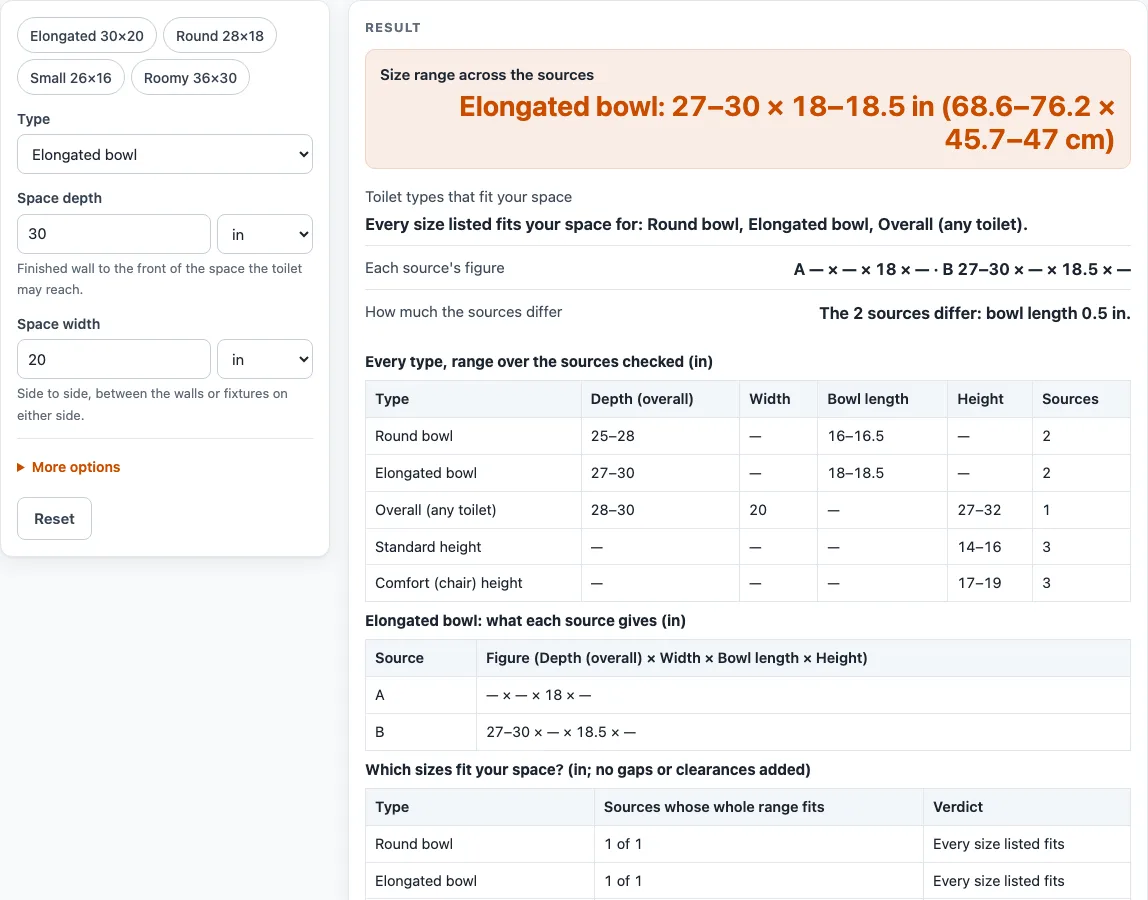
How to use the Toilet Dimensions Tool
- Open the Type menu and choose one of the five options: Round bowl, Elongated bowl, Overall (any toilet), Standard height, or Comfort (chair) height.
- In Space depth, type the depth of the space you have for the toilet.
- Open the unit menu next to Space depth and pick the unit you measured in.
- In Space width, type the width of the space.
- Open the unit menu next to Space width and pick its unit.
- Read the result line. It lists the toilet types whose depth and width fit your space, for example: “Every size listed fits your space for: Round bowl.”
- Read the size line below it. It gives the figures for the type you chose, in inches and centimeters.
- To change the units of the chart, open More options and use Show the chart in to pick inches (in) or centimeters (cm).
To try the tool quickly, press one of the example buttons: “Elongated 30×20”, “Round 28×18”, “Small 26×16” or “Roomy 36×30”. The “Reset” button restores the defaults. The check uses only depth and width. Bowl length and height appear for reference and are marked “Not a size to fit.”
Pick Overall (any toilet) to see the depth, width and height range that one source gives.
How deep is a standard toilet?
A standard toilet is usually 28 to 30 inches (71.1 to 76.2 cm) deep overall, according to Source A, which also gives a typical width of about 20 inches. Source B gives a shorter overall depth: 25 to 28 inches for round bowls and 27 to 30 inches for elongated bowls.
Overall depth is the full length of the toilet from back to front. Bowl length is a separate measurement, taken from the middle of the mounting bolts to the front of the rim. Do not confuse the two when you compare toilets.
Toilets are not standardized, so no single number is correct for every model. Check the depth of the specific toilet you plan to buy against the depth of your space.
What is the difference between round and elongated toilets?
A round bowl is shorter than an elongated bowl, and the difference is about 2 inches in bowl length. Round bowls measure about 16 to 16 1/2 inches from the mounting bolts to the front of the rim. Elongated bowls measure about 18 to 18 1/2 inches. Source C says an elongated bowl is about 2 inches longer.
The overall depth follows the same pattern. Round toilets are 25 to 28 inches deep overall and elongated toilets are 27 to 30 inches deep, according to the figures in the chart. The two sources in the chart differ by 0.5 inch on the bowl length of each shape.
Elongated bowls are longer, so they need more room from the wall to the front edge. The chart lists no separate width for each bowl shape, so the width check does not separate round from elongated.
Sources (checked 19 October 2026): bobvila.com · familyhandyman.com · fergusonhome.com
Worked examples
| Input | Result |
|---|---|
| Elongated bowl, space 30 in × 20 in | 3 type(s) fit or match every source |
| Round bowl, space 28 in × 18 in | 1 type(s) fit or match every source |
| Overall (any toilet), space 36 in × 30 in | 3 type(s) fit or match every source |
| Comfort (chair) height, space 26 in × 16 in | 1 type(s) fit or match some sources |
| Elongated bowl, space 75 cm × 50 cm | 1 type(s) fit or match every source |
Calculated by the tool above; open it with the same values to see each step.
Frequently asked questions
How wide is a toilet?
Source A gives a width of about 20 inches (50.8 cm), and it is the only source in the chart that lists width. The width check therefore rests on that one figure.
What is comfort height?
Comfort (chair) height is the seat height of taller toilets. Across the guides it ranges from 17 to 19 inches (43.2 to 48.3 cm), with Source A giving about 18 inches. Standard height is 14 to 16 inches.
What is rough-in?
Rough-in is the distance from the finished wall behind the toilet to the center of the drain. Most toilets have a 12-inch rough-in, but 10-inch and 14-inch versions also exist. Source A says a 10-inch rough-in usually needs a special order. The tool does not show or check rough-in.
Does the tool check clearance or building codes?
No. The check compares only overall depth and width against your space. It adds no clearance in front of the toilet or to its sides, and the page does not claim that any layout meets a code. Check local rules before you finish a layout.
Why does the tool warn about Overall (any toilet) sizes?
The tool shows a warning that only one source lists that row. Only Source A does, at 28 to 30 inches deep, about 20 inches wide and 27 to 32 inches high. The figure is still shown, but it cannot be checked against another guide.
Why does the chart show a range instead of one number?
The three guides give different figures, and the chart does not average them. Each range runs from the lowest figure any source gives to the highest. The line “Each source’s figure” and the table for the type you chose show every source’s own figure.
Related tools
- Bathroom Vanity Dimensions: Match a vanity to your wall length and number of sinks.
- Bath Mat Size Chart: Match a bath mat to the length of your tub or vanity.
- Towel Bar Height: Find the height for a towel bar, ring or hook.
- Toilet Paper Holder Height: Find the height for a toilet paper holder.
- Towel Sizes: Compare bath, hand and other towel sizes.