Washer and Dryer Dimensions
Enter the width, depth and height of your laundry space to see which washer and dryer setups fit, next to a chart of sizes from manufacturer spec sheets.
Recent
Your last 10 settings, saved only in this browser. Nothing is uploaded.
How to use the Washer and Dryer Dimensions tool
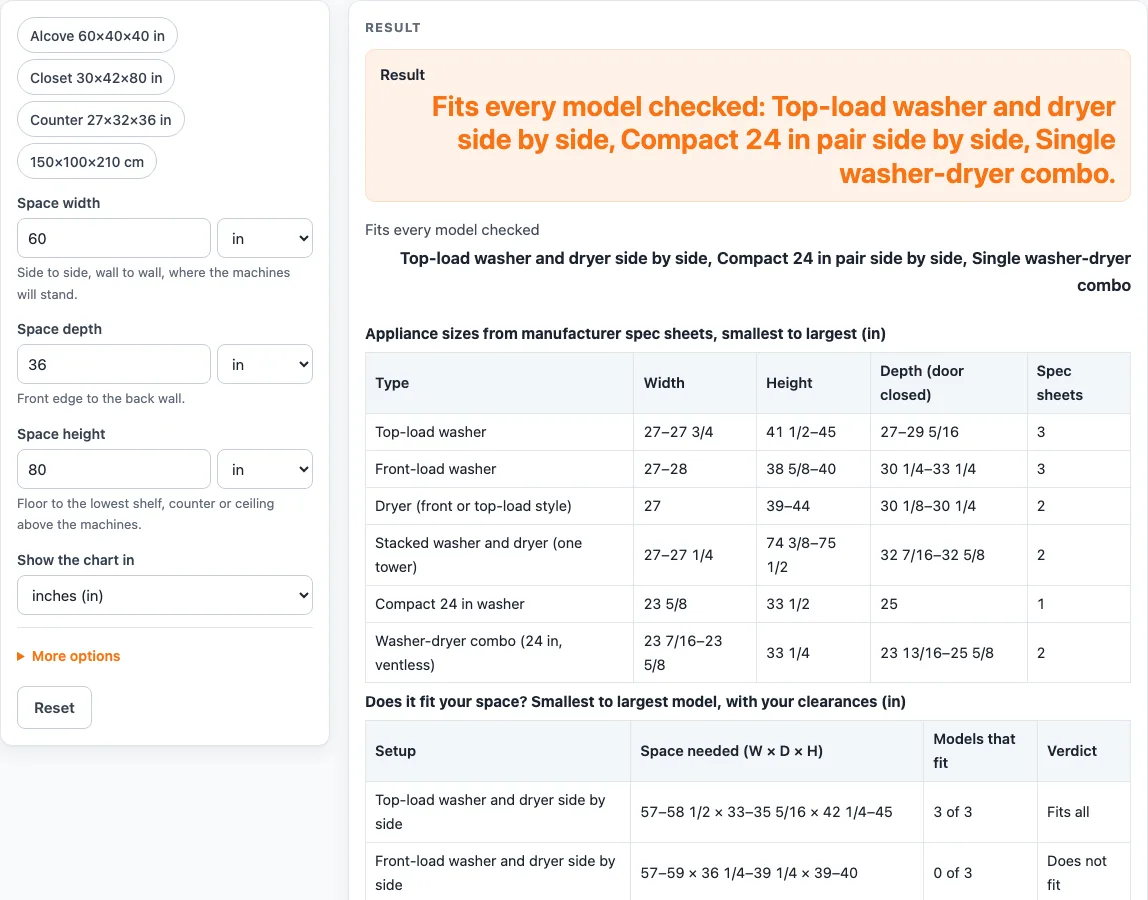
- Look at the chart first. Each of the six rows shows the smallest-to-largest width, height and depth (door closed), plus how many spec sheets that range comes from.
- Measure your space: width, depth, and height up to the lowest shelf, counter or ceiling above the machines.
- Enter those numbers in “Space width”, “Space depth” and “Space height”. You can type inches, feet, cm or m. The Examples chips, such as “Closet 30×42×80 in”, fill them for you.
- Open “More options” to check the clearances: “Clearance at each side (in)”, “Space behind the machines (in)” for hoses and the dryer vent, and “Gap between two machines (in)”. They start at 1 in, 6 in and 1 in. Change them to match your space.
- Read “Result”. It lists which setups fit every model checked and which fit only some.
- Read the table “Does it fit your space?”. For each of the five setups it shows the smallest-to-largest space needed, how many models fit, and a verdict of “Fits all”, “Fits some” or “Does not fit”.
- Open “How it was calculated”. If a setup fits, it adds a height note: top-load washers need about 56 to 57 in with the lid open.
- Check door swing yourself. The fit check does not include it, and front-load door-open depths on the sheets reach about 54 1/2 to 57 3/8 in. “Show the chart in” only changes whether the tables show inches or centimeters.
How does the tool work out the space a washer and dryer need?
The tool calculates the room each setup needs from your clearances and the sizes on the spec sheets. For a setup, the width is the number of machines times the machine width, plus the gaps between them, plus twice the side clearance. The depth is the machine depth plus the rear allowance, and the height is the tallest height on that model’s sheet.
A pair assumes the dryer is as wide and deep as the washer. That was true for the sets on the sheets checked, but it is an assumption, not a measurement of your appliances. The tool then compares the space you entered with the needed space for each model. A setup “fits all” when every model checked fits, “fits some” when only some do, and “does not fit” when none do.
Because the result depends on your clearances, changing a clearance can change the verdict. The sheets checked give different minimums. One maker lists 1 in at the sides and 4 in behind. Another lists closet minimums of 1 in at the sides and 6 in behind a washer or 5 15/16 in behind a dryer. A third tested a washer at 0 in on the sides and suggests 1 in to cut noise. A fourth lists 0 in on the sides and top for a dryer, with 1/2 in per side suggested.
Why do washer and dryer dimensions vary from model to model?
Washer and dryer dimensions vary because each maker builds to its own drum size, cabinet and controls. The chart therefore shows ranges, not averages. Top-load washers run from 27 to 27 3/4 in wide and 27 to 29 5/16 in deep. Front-load washers run from 27 to 28 in wide and 30 1/4 to 33 1/4 in deep, so the depth spread is larger than the width spread. Dryers measure 27 in wide and 30 1/8 to 30 1/4 in deep across two makers. A compact 24 in washer measures 23 5/8 in wide, and the two 24 in combos measure 23 7/16 to 23 5/8 in wide.
Stacked towers measure 74 3/8 to 75 1/2 in high, so their height decides whether they fit under a cabinet or a low ceiling. Only two sheets were checked for stacked towers, so that range rests on little data. The sources are spec and dimension sheets from five manufacturers, and one of the two combo entries comes from a parts store’s copy of a maker’s spec table, not the maker’s own PDF.
The sizes on this page describe the machines themselves. They are not a code or safety check, and they do not confirm that a space meets any building or gas requirement. The installation guide of the model you buy has the numbers that count.
Sources (checked 15 October 2026): lg.com · static.pcrichard.com · assets.ajmadison.com · lgparts.com · lg.com · lg.com · static.pcrichard.com · static.pcrichard.com · static.pcrichard.com
Worked examples
| Input | Result |
|---|---|
| Space 60 in × 36 in × 80 in | 3 setups fit every model checked |
| Space 60 in × 40 in × 40 in | 3 setups fit every model checked |
| Space 30 in × 42 in × 80 in | 2 setups fit every model checked |
| Space 27 in × 32 in × 36 in | 1 setups fit every model checked |
| Space 150 cm × 100 cm × 210 cm | 5 setups fit every model checked |
Calculated by the tool above; open it with the same values to see each step.
Frequently asked questions
What are standard washer dryer dimensions?
There is no single standard size. The chart gives ranges from the spec sheets checked, and the common width is 27 in for full-size washers and dryers. Depth and height vary more, so compare the model you plan to buy with the range shown.
Is the dryer the same size as the washer?
The fit check assumes the dryer is as wide and deep as the washer, which was true for the sets on the sheets. Dryer dimensions on the chart still come from their own sheets, so check the dryer model if you are buying one separately.
Why does a front-load washer need more depth than a top-load?
Front-load washers on the sheets run from 30 1/4 to 33 1/4 in deep, while top-load washers run from 27 to 29 5/16 in. The difference matters most in a narrow room, so the fit check measures depth separately from width.
How much height does a top-load washer need?
A top-load washer needs more height with the lid open. The sheets give 55 3/4 to 56 3/8 in on one guide and 57 1/5 in on another. The page notes this in “How it was calculated” when a setup fits.
Does the fit check cover door swing?
No. Door swing is not part of the calculation. Front-load door-open depths on the sheets reach about 54 1/2 to 57 3/8 in, so measure the room for the open door yourself.
Does a result mean the setup is approved for my home?
No. A result is calculated from your inputs and typical sizes from the named sources. It does not say a setup meets any building or gas code, so follow the installation guide of the model you buy.
Related tools
- Laundry Room Dimensions: Work out the smallest room for a washer and dryer set, an aisle and a counter.
- Dishwasher Dimensions: Check dishwasher sizes and the opening they need.
- Refrigerator Dimensions: Check refrigerator sizes and the space they need.
- Standard Kitchen Cabinet Sizes: Look up cabinet sizes.
- Pantry Dimensions: Plan shelves and storage space.
- Kitchen and laundry sizes: See every kitchen and laundry size tool on the site.