What Size Storage Unit Do I Need?
Pick your home size, or switch to a list of your boxes and furniture, to see which storage unit size to look at and how full it would be.
Recent
Your last 10 settings, saved only in this browser. Nothing is uploaded.
How to use the storage unit size calculator
- Under “I want to size my unit by”, choose “Home size (bedrooms)” or “A list of my items”.
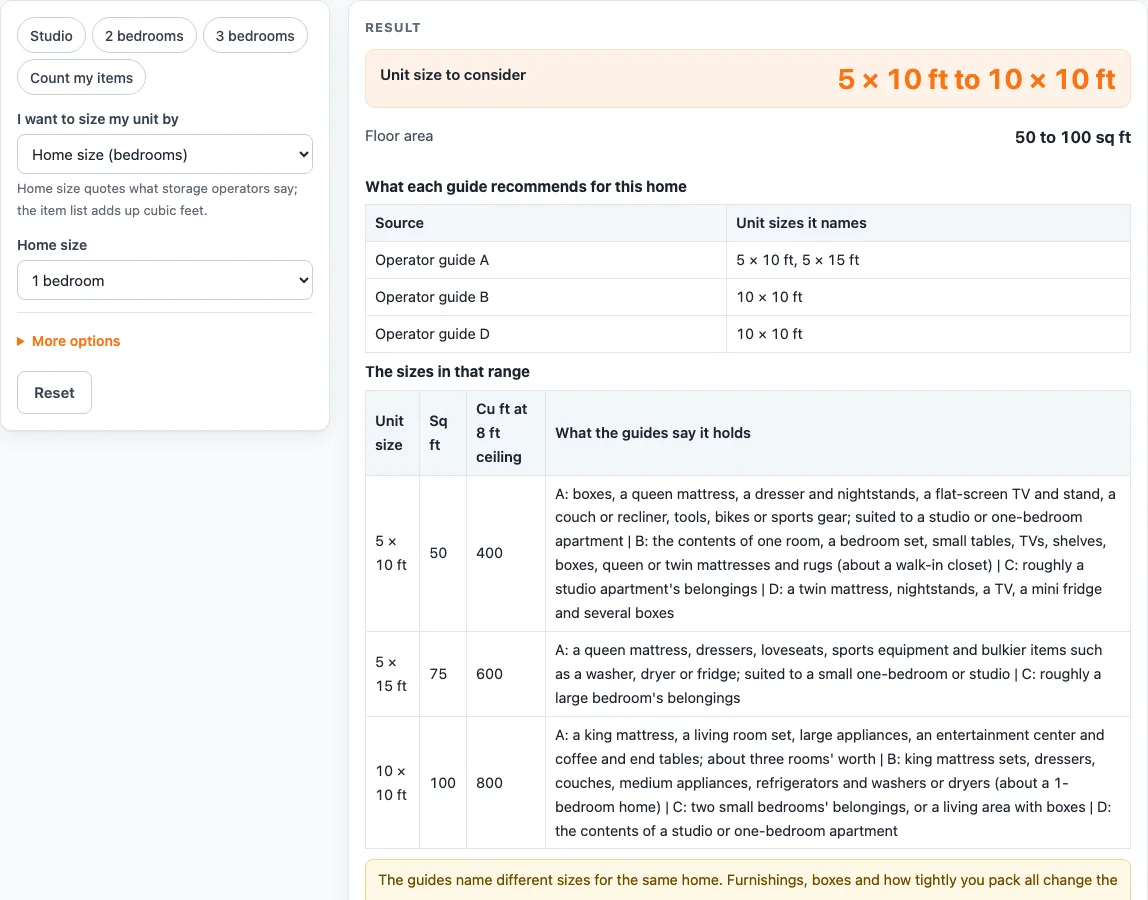
- In home size mode, pick a size from Studio to 4 bedrooms under “Home size”, or use the Studio, 2 bedrooms or 3 bedrooms preset. The page quotes what four operator guides name and shows the smallest to the largest size.
- Read “Unit size to consider” and “Floor area”, then the tables of what each guide recommends and the sizes in that range.
- For a list, choose “A list of my items”, or click the “Count my items” preset.
- Type a count for each of the 16 item types, including small, medium and large boxes, twin, queen and king beds, sofas, dining tables, refrigerators and washing machines. A blank counts as 0, and you need at least one item.
- Open more options. “Space to leave empty (%)” starts at 10 and accepts 0 to 90. Set it to 0 to fill the unit completely.
- In more options, “Usable stack height (ft)” starts at 7 and accepts 1 to 12.
- Read “Unit size to consider”, “Your items” in cubic feet and “How full it would be”. The “Your items in each standard unit” table shows the fill and whether it fits for every size.
- If your items need more than a 10 × 30 ft unit, the result says so and a warning suggests planning for two units.
Presets fill in example values, so you can change any number after clicking one.
How does the calculator work out the size of a storage unit?
The calculator adds the packed volume of every item you enter, in cubic feet. It then compares that total with the usable volume of each standard unit, which is width × depth × stack height. The recommended unit is the smallest size whose usable volume, minus the “Space to leave empty” allowance, is at least the total.
For example, the default items add up to 258 cu ft. That is 73.7 percent of a 5 × 10 ft unit, which has 350 cu ft of usable volume at the 7 ft default stack height. A 5 × 5 ft unit has 175 cu ft, which is too small. Another example is ten medium boxes and a twin bed. Together they make 70 cu ft, which is 40 percent of a 5 × 5 ft unit.
The 10 percent of empty space and the 7 ft stack height are this page’s own planning assumptions, not figures from any source. Units are about 8 ft tall, and some facilities have taller ceilings, so ask the facility if you plan to stack higher.
Packed volumes are larger than the items’ own volumes. They include the space an item takes on a moving truck, including awkward gaps. The per-item figures come from one public source, the State of Alaska Department of Public Safety household goods move cube sheet. The box figures of 1.5, 3 and 4.5 cu ft for small, medium and large boxes come from a moving box guide.
Why do the size guides disagree for the same home?
For a home size, the page quotes what four operator guides recommend and shows the smallest and largest size they name. It does not average them and does not invent a figure. For a studio, the guides name sizes from 5 × 10 ft to 10 × 10 ft, which is 50 to 100 sq ft. For 3 bedrooms, the span is 10 × 20 ft to 10 × 30 ft, which is 200 to 300 sq ft.
The guides differ because homes, furniture and packing differ. One guide says a 10 × 10 ft unit holds about three rooms. Another says it holds about a one-bedroom home, a third says two small bedrooms, and a fourth says a studio or one-bedroom apartment. When the span covers more than one size, the page shows a warning. Treat the span as a range to compare with your own list of items, not as a single answer.
Sources (checked 15 October 2026): cubesmart.com · storagecafe.com · uhaul.com · publicstorage.com · aws.state.ak.us · hireahelper.com · hondanews.com · fromtheroad.ford.com · tsishipping.com · thumbtack.com · redfin.com · storagecafe.com
Worked examples
| Input | Result |
|---|---|
| Home size: 1 bedroom | Guides name 5 × 10 ft to 10 × 10 ft |
| Home size: Studio | Guides name 5 × 10 ft to 10 × 10 ft |
| Home size: 3 bedrooms | Guides name 10 × 20 ft to 10 × 30 ft |
| 9 kinds of item, stack height 7 ft | 258 cu ft, smallest unit 5 × 10 ft |
| 2 kinds of item, stack height 7 ft | 70 cu ft, smallest unit 5 × 5 ft |
Calculated by the tool above; open it with the same values to see each step.
Frequently asked questions
Is the storage unit size calculator free to use?
Yes. It runs in your browser, and no sign-up is needed.
Does the calculator store or upload what I type?
No. Nothing is stored or uploaded. The calculation runs in the browser.
What does “Space to leave empty” do, and should I change it?
It sets how much of each unit’s usable volume is kept empty for gaps and a walkway. It defaults to 10 percent, which is the page’s own planning allowance and not a figure from any source. Set it to 0 to fill the unit completely.
What if my stack height is above 8 ft?
The page shows a warning, because most units have about 8 ft ceilings. Some facilities have ceilings of 10 to 12 ft, so ask the facility before you plan around a taller stack.
What if my items need more than a 10 × 30 ft unit?
The result says so and suggests planning for two units. Check the item counts first, because a small change can make a large difference to the total.
Do the operator guide sizes match at every facility?
No. Operators’ unit sizes vary slightly, so check the exact unit before you rent. The tables call the four guides operator guide A, B, C and D, and they sometimes disagree about what a size holds.
Related tools
See all storage and moving tools, or open one of these.
- How Big Is a 10x10 Storage Unit?: use it for the space and typical contents of a 10 × 10 ft unit.
- How Big Is a 5x10 Storage Unit?: use it when your items seem to fit a 5 × 10 ft unit.
- Moving Box Calculator: use it to estimate how many boxes you need before you pack.
- Moving Box Sizes: use it to compare box dimensions when you plan what to pack.
- What Size Storage Unit for a Car?: use it when the item you are storing is a vehicle.
- Storage Unit Sizes: use it for an overview of the standard unit sizes.